Key takeaways
- Lagos serviced apartments compete on space, privacy, and consistency more than on room count alone.
- Operators need hotel-style housekeeping, stock control, and guest messaging to avoid the chaos that usually hits shortlet businesses.
- Distribution should be balanced across direct bookings, OTAs, and trusted third-party channels, with clear rules for deposits and minimum stays.
- Owners who track stay length, cleaning cadence, and leakage by unit make better pricing and reinvestment decisions.
Table of contents
- 1. Why Lagos serviced apartments keep winning
- 2. What the 2026 Lagos guest actually buys
- 3. How serviced apartments differ from hotels and shortlets
- 4. What Lagos guests translate from the label
- 5. Pricing and distribution choices that matter in Lagos
- 6. Signals that a Lagos serviced apartment is actually built for the market
- 7. A practical Lagos management checklist
- 8. What to ask before you expand or buy another unit
Article overview
Primary keyword
serviced apartments in Lagos
Category
Market Intelligence
Location focus
Nigeria, Lagos, Lekki
Written by
Onome James
Service Excellence & Strategy Lead
Covers guest experience, market positioning, and service strategy for Nigerian hotels, serviced apartments, and shortlet operators.
Editorial standards
Staycore insights are written for operators, reviewed for practical accuracy, and structured for search and AI retrieval.
View standardsWhy Lagos serviced apartments keep winning
Lagos continues to reward properties that solve a specific guest problem: people want hotel convenience without losing the space, privacy, and flexibility of an apartment. That is why serviced apartments keep taking share from both traditional hotels and informal shortlets. The winners are not the loudest listings. They are the properties that are clean, predictable, easy to book, and tightly controlled.
The market is not rewarding vague positioning. Guests want to know whether they are booking a business stay, a family stay, a relocation stay, or a longer work assignment. That means your serviced apartment should be presented as a hospitality asset with a clear operating model, not as a spare flat that happens to be online.
This guide is for owners in Lagos, Lekki, Victoria Island, Ikeja, and surrounding commercial corridors who want to run serviced apartments as a proper business. If you are still managing by memory, WhatsApp threads, and paper notes, you are leaving margin on the table. Start with the modern shortlet management guide for Nigeria and use this article to understand the Lagos-specific market.
What the 2026 Lagos guest actually buys
The typical serviced apartment guest in Lagos is not only looking for a bed. They are buying flexibility. That may be a business traveler who needs a quiet work base, a family that wants a kitchen and separate living area, a relocating professional, or a diaspora guest who wants a home-like stay with dependable service.
The lesson is simple: your unit should be presented and priced around use case, not just square footage. Guests need to understand whether the unit is built for a one-night business stop, a week-long work trip, or a longer stay with family. Your listing, photos, and rate rules should make that obvious within seconds.
| Guest type | What they buy | What the unit must deliver |
|---|---|---|
| Business traveler | Speed and reliability | Fast check-in, stable Wi-Fi, clear billing, quiet workspace |
| Family stay | Space and comfort | Separate living area, kitchen, laundry expectations, easy access |
| Relocation stay | Stability and trust | Longer stay rates, support, clear receipts, controlled access |
| Diaspora visit | Familiarity with structure | Clean presentation, premium finish, strong communication |
That matters when you price, package, and market the unit. If you are selling a stay for work, the page should make the workspace, internet quality, and billing rules obvious. If you are selling a family stay, the page should lead with space, comfort, and kitchen utility. The wrong framing makes the best unit look ordinary.
How serviced apartments differ from hotels and shortlets
A serviced apartment sits between a hotel and a shortlet, but the label only works if the operating promise is distinct. Hotels are structured around service and front-of-house discipline. Shortlets are usually more flexible and individually managed. Serviced apartments should combine apartment-like comfort with hotel-grade consistency.
That difference affects the guest journey, the staffing model, and the channel strategy. If the apartment is sold as premium, the guest expects hotel-level cleaning, communication, and billing discipline. If it is sold as casual, the market will treat it like a lower-trust listing.
| Model | Guest promise | Operational risk |
|---|---|---|
| Hotel | Service, structure, support | Higher staffing needs and sharper SLA pressure |
| Shortlet | Flexibility, space, personality | Inconsistent quality if controls are loose |
| Serviced apartment | Residential comfort with hospitality control | Margin leakage if housekeeping and access are weak |
That is where a system like operations governance and inventory and cost control become practical, not theoretical. Run every stay with a simple question in mind: what happens before arrival, during the stay, and after departure? If that journey is not mapped, margin leaks through exceptions.
What Lagos guests translate from the label
Guests in Lagos are rarely buying the phrase "serviced apartment" by itself. They translate it into a set of expectations: can I work here, can I sleep well, can I cook, can I park, can I extend, and will someone answer if something goes wrong? The stronger the answer to those questions, the easier the sale.
That is why the listing copy, photos, and house rules need to feel operational rather than decorative. Show the guest the real stay path. Do not make them infer it from luxury language alone.
| Guest question | What the listing should answer |
|---|---|
| Can I stay for one night or longer? | State minimum stay and extension rules clearly |
| Can I work remotely? | Show desk setup, Wi-Fi expectations, and quiet zones |
| Can I bring family? | Explain bedrooms, living space, and child-friendliness |
| Can I check in smoothly? | Document arrival, payment, and access steps |
Pricing and distribution choices that matter in Lagos
The best serviced apartment businesses in Lagos do not depend on one channel. They blend direct bookings, OTA visibility, repeat guests, corporate referrals, and local partnerships. The goal is not occupancy at any cost. The goal is controlled occupancy with healthy net revenue.
Pricing should reflect the use case. Weeknight business demand, weekend leisure demand, and longer stay demand should not all be treated the same. A smart serviced apartment operator builds price ladders around stay length, season, and lead time rather than reacting with random discounts.
- Protect direct bookings with a clean website and booking engine.
- Use channel manager discipline so rates and availability stay aligned.
- Set minimum stay rules for periods when cleaning and turnaround costs are higher.
- Keep corporate rates separate from leisure and short-stay pricing.
- Track which channels produce repeat guests versus one-off volume.
For operators that want to understand the broader distribution logic, the existing channel management guide remains useful. The difference in 2026 is that serviced apartments now need the same discipline that hotels have used for years, plus the flexibility that apartment-style inventory demands.
The channel mix should also change by unit type. A compact business studio may perform better on shorter stays and direct bookings. A larger family-ready unit may justify longer stays, stronger prepayment rules, and more emphasis on trust-heavy channels. The operator has to decide what each unit is for, rather than letting every unit compete for every booking.
Signals that a Lagos serviced apartment is actually built for the market
Not every furnished unit deserves the serviced apartment label. The market reads the difference quickly. Serious properties have repeatable check-in windows, consistent photos, disciplined deposits, and a management rhythm that does not depend on one person being on WhatsApp all day. If those signals are missing, the unit is probably being run as casual rental stock, not hospitality inventory.
In Lagos, that distinction matters across Lekki, Victoria Island, Ikoyi, Ikeja, and the mainland business corridors. Corporate guests, families, and short-stay travelers all notice when access is messy, cleaning is inconsistent, or the product changes from unit to unit.
| Signal | What it tells the market | What the operator should be doing |
|---|---|---|
| Clear check-in process | The stay is professionally managed | Use one documented arrival workflow |
| Uniform unit presentation | The portfolio is controlled | Standardize linens, amenities, and photos |
| Deposit and payment rules | The business values discipline | Set rules before the booking is confirmed |
| Maintenance turnaround | The property can recover quickly after issues | Track work orders by unit and urgency |
Operators should also pay attention to response time. In this market, a slow reply can undo a great unit. Guests compare the speed of your response with the speed of an Airbnb host, a hotel front desk, and a competitor listing. The property that replies cleanly and confidently usually wins the first conversation.
A practical Lagos management checklist
Use this as a baseline for every unit in your portfolio:
- Standardize linen, amenities, and room presentation across all units.
- Track every cleaning, inspection, and maintenance task by unit and date.
- Separate direct, OTA, and referral bookings in reporting.
- Enforce deposits, house rules, and check-in standards consistently.
- Monitor replacement costs for consumables and damaged items.
Then add a second layer of control. Measure how long each unit stays out of service after departure, how often guests request exceptions, and where approvals are slowing down the team. That data tells you whether your portfolio is disciplined or just busy.
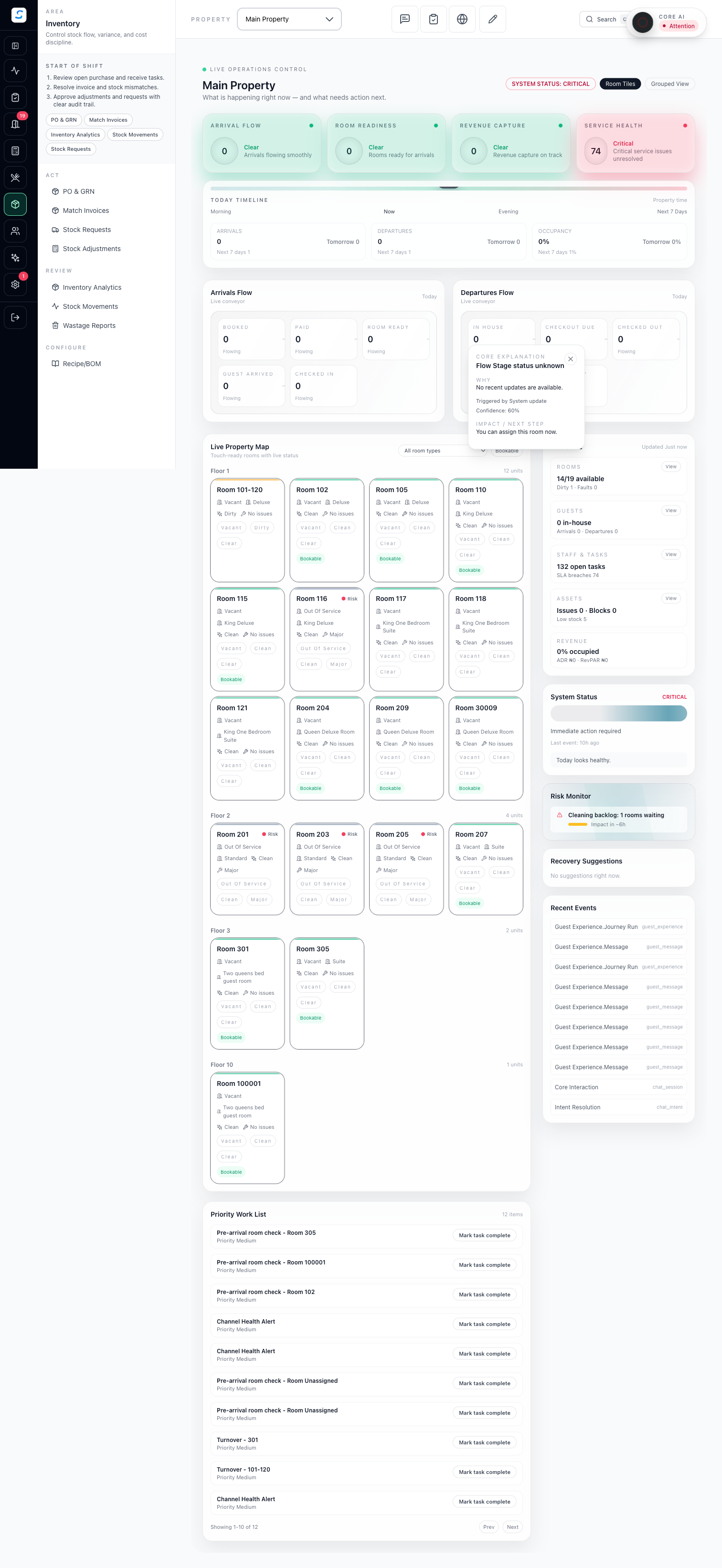
If your guest promise is premium, the operation must be premium too. That does not mean overcomplicated. It means controlled, visible, and repeatable. That is the operating difference Staycore is built to support.
What to ask before you expand or buy another unit
If you are evaluating a Lagos serviced apartment portfolio, start with control rather than vanity metrics. Look at occupancy by unit, stay length by channel, cleaning turnaround time, and leakage points across payments and stock. Once the basics are visible, your pricing and expansion decisions become much easier.
Before adding more units, ask whether the current operation can answer the same guest question five times in a row without improvisation. If the answer is no, more inventory will only multiply the problem.
- Can the team see live availability by unit and status?
- Are deposits, extensions, and refunds handled in one clear flow?
- Can housekeeping and maintenance work from a single task list?
- Do you know which channels create repeat guests, not just volume?
- Can the owner see revenue by unit without waiting for a manual report?
That is also why the shortlet management guide and the Airbnb market article matter here. Lagos serviced apartments sit between those two worlds, so the operating model has to borrow the best of both without becoming sloppy.
If you get the operating model right, the serviced apartment stops behaving like a loose rental and starts behaving like a revenue asset. That is the difference the market rewards over time: consistency, not improvisation.
Book a Staycore demo if you want to see how one control layer can run bookings, guest operations, and revenue discipline across multiple serviced apartments.
FAQ
Frequently asked questions
What is a serviced apartment in Lagos?
Is a serviced apartment the same as a shortlet?
Should serviced apartments use a channel manager?
How can Staycore help?
What matters most in Lagos?
Next step
Book a Staycore demo
See how Staycore brings revenue control, guest visibility, and operational discipline into one operating layer.
Series navigation
Nigeria Market Intelligence
Location-aware, search-ready editorial for Lagos, Abuja, and broader Nigeria hospitality demand, operating standards, terminology, and guest expectations.
Next in series
Top Hospitality Trends in Nigeria for 2026