Key takeaways
- Hotel and shortlet taxes matter most when revenue records are weak, fragmented, or poorly explained.
- Operators should think in tax categories, permits, payroll obligations, and state or local levies rather than one generic compliance bucket.
- A cleaner operational record makes tax reporting, pricing, and audit defense easier.
- The goal is not just compliance. It is protecting margin by understanding what the business owes and why.
Table of contents
- 1. Overview
- 2. Why tax clarity matters in hospitality
- 3. The main taxes and levies operators should expect
- 4. What shortlets must pay attention to
- 5. The records every operator should keep
- 6. How taxes affect pricing decisions
- 7. Common compliance mistakes operators make
- 8. A practical compliance workflow for operators
- 9. What good operators do differently
Article overview
Primary keyword
Nigerian hotel taxes and levies
Category
Guides
Location focus
Nigeria, Lagos, Abuja
Commercial guide
Compare the operating system behind this guidance.
If you are evaluating software for a Nigerian hotel, review the evergreen Staycore buyer page for PMS, payments, rooms, POS, staff controls, and reporting.
Hotel Software NigeriaWritten by
Kingsley Uzondu
Growth & Alliances Lead
Focuses on growth strategy, partnerships, direct demand, and commercial positioning for hotels, shortlets, and hospitality groups using Staycore.
Editorial standards
Staycore insights are written for operators, reviewed for practical accuracy, and structured for search and AI retrieval.
View standardsOverview
If you run a hotel, serviced apartment, or shortlet business in Nigeria, taxes and levies are not a side issue. They shape pricing, cash flow, reporting, and the quality of decisions you can make every month. The problem is that many operators only think about tax when a demand notice arrives, a regulator visits, or an accountant asks for records that do not exist in one place.
That reactive approach is expensive. It encourages guesswork, encourages staff to keep unofficial records, and makes it easy for revenue to leak through the cracks. A property that understands its obligations can price more intelligently, plan better, and avoid the kind of shocks that turn profit into panic.
This guide is written for operators, not tax lawyers. It is meant to help hotel and shortlet owners understand the categories of taxes and levies they are likely to encounter, the records they should keep, and the operational habits that make compliance easier. The rules can vary by state, local authority, property type, and business structure, so treat this as a working operator's guide and confirm details with a qualified professional before filing or paying anything material.
Why tax clarity matters in hospitality
Hospitality businesses in Nigeria tend to have thin margins once you factor in power, staffing, maintenance, commissions, and seasonal demand swings. That means every line item matters. A tax that is not planned for becomes a margin problem. A levy that is not tracked becomes a cash-flow problem. A permit that is ignored becomes an interruption problem.
For hotels and shortlets, tax clarity also protects revenue integrity. If a property sells rooms, F&B, event space, or add-on services without proper records, the same weak process that causes leakage will also make tax reporting unreliable. In other words, compliance and control are connected. You cannot separate them cleanly if your business still runs on paper slips, verbal handovers, and memory.
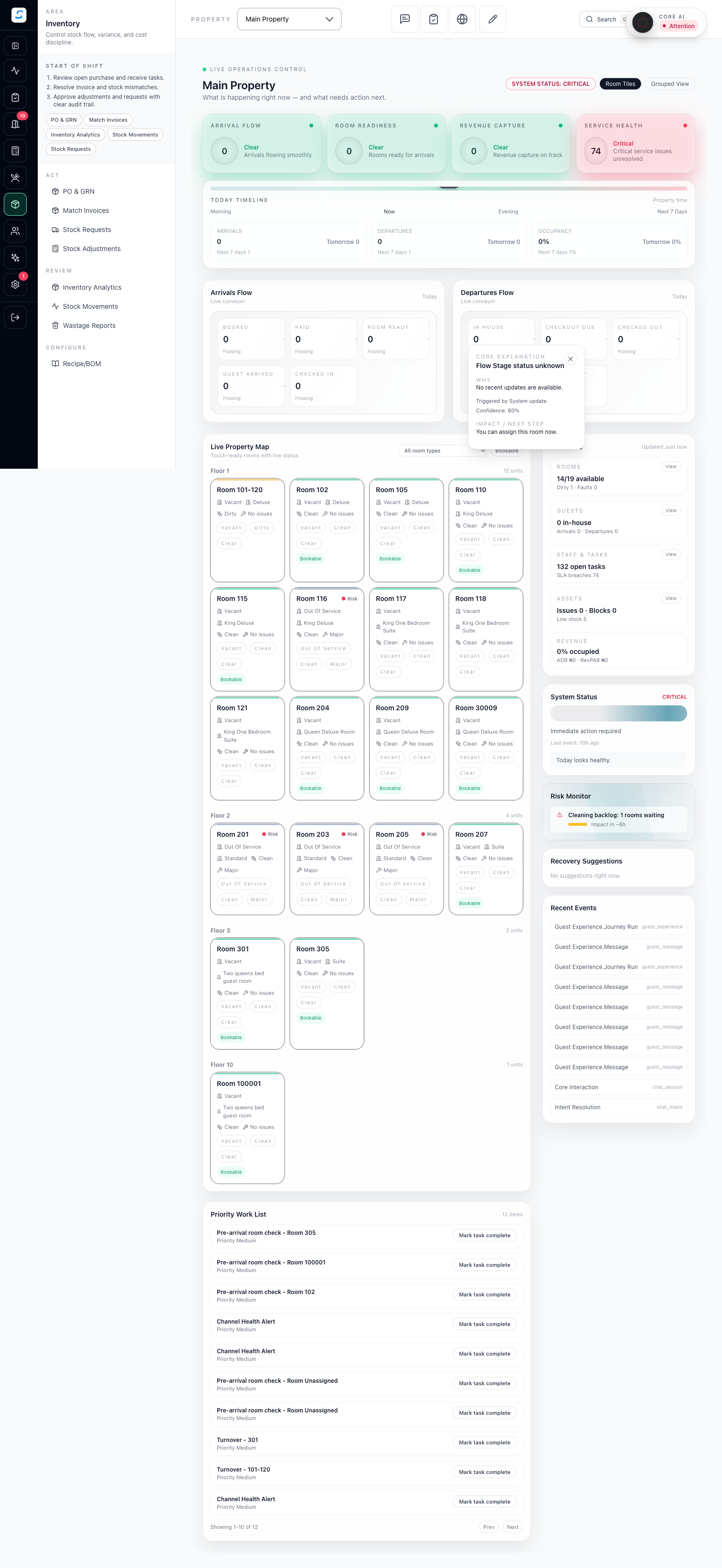
This is one reason Staycore focuses so much on control workflows. The Revenue Leakage Control and Operations Governance modules are useful not because they are accounting tools, but because they help create a trustworthy operating record. Once bookings, charges, approvals, and room status live in one system, the business has a far better chance of reconciling what was sold, what was collected, and what should be reported.
The main taxes and levies operators should expect
The exact mix varies by location and business structure, but most Nigerian hotel and shortlet operators will run into some version of the following.
1. Company income tax and business income obligations
If your hospitality business is incorporated, company-level tax obligations will usually apply based on the structure and profitability of the business. If you operate as an unincorporated business, there may still be personal or business income implications depending on how the operation is set up and documented.
The practical lesson is simple: do not mix business revenue with personal spending and expect clean reporting later. Use a business account, keep invoices and receipts, and make sure every room booking, package sale, and service charge can be traced back to a real transaction.
2. VAT and consumption-related charges
Many hospitality businesses need to understand how VAT or other consumption-related charges apply to their sales. The exact treatment depends on the transaction type, the business model, and current rules. Rooms, food and beverage, laundry, event rentals, and ancillary services may not all be treated the same way.
This is where good documentation matters. If you do not know which revenue lines are being taxed, you cannot build the right price architecture. If your staff use manual receipts or inconsistent item names, your accountant will spend more time cleaning data than analyzing it.
3. PAYE and payroll-linked obligations
Any hotel or shortlet operation with staff needs a proper payroll process. PAYE and related employment obligations are not just a finance issue. They are an HR issue and a governance issue. If employees are paid informally, if allowances are undocumented, or if shifts are not tracked, your payroll records will not match your actual labour cost.
For operators who are trying to stabilize wage costs, the best move is not to avoid structure. It is to create clarity around roles, shifts, approvals, and department-level accountability. The Teams & Departments page is relevant here because staffing becomes easier to manage when every role has a clear owner and a measurable scope.
4. State and local levies
Depending on where the property sits, you may encounter state tourism charges, accommodation-related levies, signage fees, local business permits, environmental charges, waste collection costs, or other location-specific payments. These are often the most confusing because they are not always standardized across the country.
The danger is not only the charge itself. The danger is the surprise. A levy that was not forecast in your pricing model can distort margins, especially for shortlets and smaller hotels that operate on a tighter base. Operators should maintain a simple compliance calendar that records who is responsible for each payment, the due date, the evidence of payment, and the department that owns the process.
5. Property and occupancy-related permits
Hotels and shortlets often need more than a business registration. Depending on the property type, you may need approvals related to occupancy, fire safety, environmental standards, building use, guest registration, or local operating conditions. Again, this varies by location, but the operator's job is to treat compliance as a recurring operating task rather than a one-time setup event.
If your property has expanded, added units, started hosting events, or shifted from one use case to another, revisit the permit picture. Businesses often get into trouble not because they never registered, but because they outgrew their original setup and never updated the paperwork.
6. Sector-specific tourism and hospitality charges
Some states and local bodies apply hospitality-specific charges or tourism-related obligations. These may be tied to room nights, classification, registration, or recurring renewals. They are easy to ignore if the business is focused only on occupancy, but they are part of the real cost of doing business.
This is why your revenue report should not stop at occupancy. Use Revenue Intelligence to see sales by room type, channel, department, and period. When management can see revenue by source, it becomes easier to understand whether a levy is something the business can absorb, recover through pricing, or reduce through process change.
What shortlets must pay attention to
Shortlets are often treated like lighter versions of hotels, but the compliance burden can be just as real. In some cases it is worse because the business grows quickly, operates across multiple locations, or mixes personal property use with commercial rental income.
Shortlet operators should pay extra attention to:
- How the property is legally registered and who owns the revenue.
- Whether guest screening, record keeping, and payment capture are consistent.
- How platform commissions affect reported gross and net income.
- Whether utilities, cleaning, and maintenance are bundled into pricing or tracked separately.
- Whether the property use aligns with local building and operating rules.
If your shortlet model depends on frequent guest turnover, then your booking records, cleaning logs, and payment trail must be disciplined. The Modern Shortlet Management Guide for Nigeria is a useful companion because it explains the operating side of the business. Taxes become much easier when the underlying operation is already well controlled.
The records every operator should keep
A tax bill is easier to handle when the business keeps clean evidence. At minimum, every hotel and shortlet should maintain:
- Daily sales summaries by revenue line.
- Bank deposit records matched to room and service sales.
- Issued invoices and payment confirmations.
- Payroll and contractor records.
- Permit renewals and payment receipts.
- Departmental expense records for cleaning, maintenance, utilities, and security.
- Occupancy reports that can be traced to actual bookings.
This is where a lot of operators lose the battle. They have money moving, but not data moving. They can prove that cash came in, but not why, when, or under what booking condition. That makes tax work harder and exposes the business to internal leakage. The article Why Most Nigerian Hotels Lose Revenue to Off-Book Room Sales explains the risk from the control side.
The operational fix is to create a single source of truth. If the front desk, housekeeping, finance, and management are not looking at the same live record, reconciliation becomes a monthly argument instead of a daily habit. The Hospitality Operating System resource explains how connected workflows solve that problem across the property.
How taxes affect pricing decisions
A common mistake in Nigerian hospitality is to think pricing is only about competitors. In reality, pricing should reflect your real operating burden. If a property has heavy payroll, multiple levies, commissions from OTAs, and a high utility bill, the room rate must be built around that reality.
That does not mean simply adding every cost and hoping the market accepts it. It means understanding your cost base enough to choose the right mix of direct bookings, channel sales, minimum stay rules, package pricing, and upsells. If you do not know your tax and levy burden, you cannot know your true margin.
Use Revenue Intelligence to see which room types, channels, and guest segments actually pay back. A property that sells a lot of rooms through high-commission channels may look busy while quietly giving away profit. Once that becomes visible, pricing becomes a management decision rather than a guess.
If you need to evaluate whether your current stack can support that level of visibility, review Staycore pricing or request a walkthrough through Contact. For teams that want to move quickly, Start free setup is the fastest way to begin evaluating the platform.
Common compliance mistakes operators make
Most penalties and surprises are not caused by one dramatic error. They come from repeated small mistakes.
The first mistake is treating every levy as negotiable or temporary. A fee you delay once becomes a habit you repeat every quarter. The second is mixing room revenue with personal spending, which makes tax reporting confusing and weakens audit credibility. The third is not documenting staff roles, which turns payroll into guesswork and increases the risk of false expenses.
Another common mistake is relying on spreadsheets that only one person understands. If that staff member leaves, the business loses memory. If the business is ever audited, the missing context becomes a liability. A proper operations record should be understandable to management, finance, and control staff without a long verbal explanation.
Finally, many operators do not reconcile bookings against cash and bank records daily. That is a tax problem and a fraud problem. If the business can see anomalies early, it can fix them early. If it waits until month-end, the damage is usually already spread across several departments.
A practical compliance workflow for operators
You do not need a giant accounting department to get this right. You need a repeatable process.
Start with a master compliance calendar. Put every recurring tax, permit, renewal, and reporting deadline in one place. Assign an owner to each item. Then connect revenue capture to accounting by ensuring every booking, extension, cancellation, and ancillary sale enters the same system of record.
Next, reconcile at the department level. Front desk, housekeeping, bar, restaurant, and events should not all close their day differently. They should close into one operational framework. That is where Operations Governance is useful because it helps make the approval chain visible and consistent.
Then review the numbers monthly. Do not just ask what was collected. Ask what was sold, what was billed, what was paid, what is outstanding, and what evidence exists. When revenue and tax work are connected, the business can price with discipline instead of emotion.
What good operators do differently
The best-run hotels and shortlets in Nigeria do not treat compliance as a burden they hope to survive. They use it as a sign of maturity. They know that the more disciplined the records, the easier the tax conversation. They know that a clean booking record reduces leakage. They know that stronger governance makes staff less likely to improvise.
That is the mindset Staycore is built for. The platform is designed to help operators unify bookings, departments, revenue, and approvals so the business can run with fewer blind spots. If you want to see how that looks in practice, start with the Hospitality Operating System, review the Revenue Leakage Control module, and compare it against your current workflows.
The real goal is not tax paperwork. The real goal is a business that knows what it owes, what it earned, and what it kept. That is how operators protect margin in a market where every naira matters.
FAQ
Frequently asked questions
What is the first tax discipline a hotel should build?
Do shortlets face the same tax clarity problem as hotels?
Why are levies such a challenge for operators?
How can Staycore help?
Next step
Explore Staycore Revenue Protection
See how Staycore helps operators protect revenue across bookings, charges, approvals, and operational exceptions.
Series navigation
PMS and Profitability
This cluster connects software buying intent to the commercial workflows that protect profit: PMS selection, booking engines, direct bookings, OTAs, RevPAR, and pricing structure.