Key takeaways
- Software only creates value when it reduces manual work and closes operational gaps.
- A modern PMS should unify rooms, payments, housekeeping, inventory, POS, and guest communication.
- Cloud-first systems are usually the better fit for Nigerian operators that need remote visibility and lower IT overhead.
- The best vendor is the one that makes your daily decisions cleaner, faster, and easier to audit.
- Profitability improves when the system is designed around control, not just reservations.
Table of contents
- 1. What hotel software has to solve in Nigeria
- 2. Key Takeaways
- 3. The capabilities that matter most
- 4. What a real integrated platform changes
- 5. Cloud-first beats old infrastructure in most Nigerian cases
- 6. How to evaluate a vendor before you commit
- 7. How profitability actually improves
- 8. What should change in the first 90 days
Article overview
Primary keyword
hotel management software Nigeria
Category
Guides
Location focus
Nigeria, Lagos, Abuja
Written by
Emmanuel Omobude
CEO
Leads Staycore with a focus on revenue control, operating discipline, and modern hospitality systems for Nigerian properties.
Editorial standards
Staycore insights are written for operators, reviewed for practical accuracy, and structured for search and AI retrieval.
View standardsWhat hotel software has to solve in Nigeria
A hotel in Nigeria does not lose money in one dramatic event. It leaks slowly: a room is comped without approval, a bar bill is posted late, housekeeping updates are not visible, or a manager only discovers the mismatch at the end of the week. That is why hotel management software is not a software purchase in the abstract. It is a control decision.
The right system gives you one operational picture. Reservations, room inventory, housekeeping, payments, and guest communication should all move through the same platform. If that picture is fragmented, the property spends more time reconciling than serving. That is the opposite of profitability.
Key Takeaways
- Choose software that unifies front desk, housekeeping, inventory, and payments.
- Treat audit trails as a profit feature, not an administrative extra.
- Prefer systems that support remote visibility for owners and managers.
- Use distribution, booking engine, and reporting tools together, not in isolation.
- Buy for the daily workflow your team actually runs, not for a feature list you will not use.
The capabilities that matter most
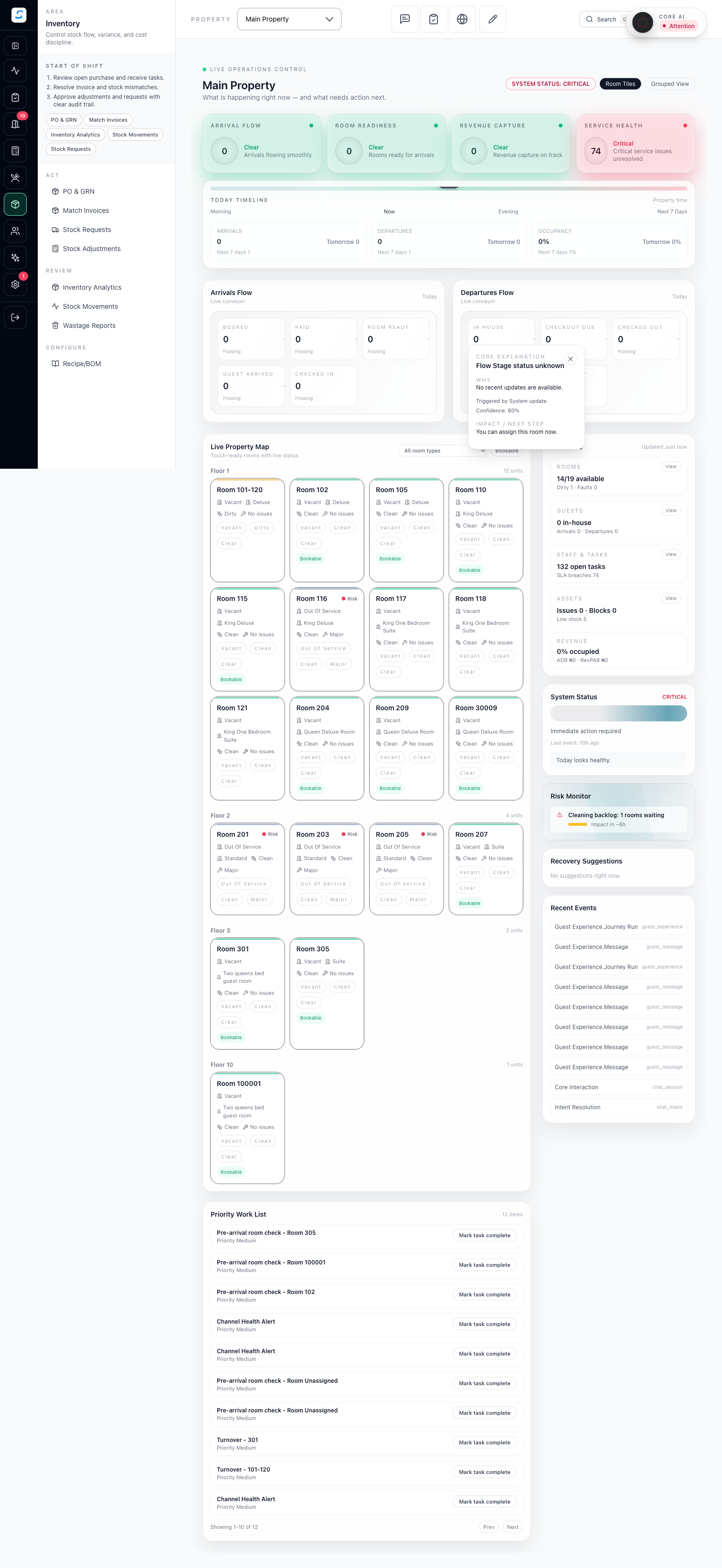
The first capability to look for is a clean front desk workflow. Arrival, room assignment, payment posting, folio edits, and check-out should feel straightforward enough that a night shift team can use the system without improvising. If the software makes basic tasks feel like configuration work, adoption will stall.
Next is housekeeping visibility. A manager should know which rooms are vacant, dirty, in progress, inspected, or blocked without calling three people. That single source of truth shortens turnaround time and reduces the chance of selling the wrong room. The same logic applies to maintenance and task handoffs.
Inventory and outlet controls are equally important for hotels that run restaurants, bars, mini-marts, or event service. If a bottle, plate, or stock item leaves a shelf without being reflected in the system, the ledger is already wrong. That is why the smarter operators tie POS and stock movement into the same workflow. See the same logic in our channel manager guide and the broader pricing page.
At the high-control end of the market, that unified workflow should extend beyond rooms and reports into the physical operation itself. Concierge activity, F&B and restaurant operations, inventory, recipe and BOM control, and access control should sit inside one cloud platform rather than across disconnected tools that only reconcile after the fact.
The real differentiator is native access control. If the locks are embedded directly inside the operating system, room access can be governed by the same booking and payment state that controls the folio. If a room has not been paid for, the door does not open. If a guest extends but the system is not updated, access is revoked automatically at the original cutoff. If an early check-in is granted casually but never recorded, access is not issued. That is what it means for operational and financial actions to be enforced physically rather than only reported later.
What a real integrated platform changes
Integrated hospitality software is only useful when it removes the need to reconcile different systems at the end of the day. When rooms, outlets, inventory, and access control are separate, the business spends more time checking the truth than running the business.
| Decision point | Good sign | Weak sign |
|---|---|---|
| Room access | Access is governed by booking and payment status in the PMS | Locks and room access sit in a separate tool that can drift out of sync |
| Food and beverage | POS, recipe, and outlet activity post into the same record | Outlet sales must be manually reconciled after service |
| Inventory | Stock movement, BOM usage, and approvals are visible together | Store issues and consumption are tracked in different places |
| Service recovery | Guest requests, assignments, and status updates are traceable | The team relies on WhatsApp threads and memory |
That level of integration matters because the business does not need a report that explains leakage after the fact. It needs an operating layer that makes the leak harder to create in the first place.
Cloud-first beats old infrastructure in most Nigerian cases
For a large share of Nigerian properties, cloud software is easier to live with than on-premise infrastructure. It reduces the burden of local servers, update cycles, backup discipline, and support that depends on someone physically being on site. The owner can see what is happening from Lagos, Abuja, or outside the country without asking for a manual export.
That does not mean cloud is perfect. It still depends on sensible connectivity, good permissions, and staff training. But the operating cost is usually lower, the upgrade path is cleaner, and the organization is less exposed to one machine becoming the only point of failure. If you want a deeper comparison, the next step is the cloud vs on-premise PMS guide.
A serious system should also help with compliance, role-based access, and reporting by outlet or property. The software should adapt to your operation instead of forcing the operation to adapt to the software.
How to evaluate a vendor before you commit
Ask the vendor to walk you through the exact flows your team uses every day. If the demo cannot show a walk-in check-in, a room move, a refund, a housekeeping update, and an outlet bill in one continuous story, the product may be too fragmented for real use.
- Ask how audit trails work and whether staff actions are logged by name.
- Check whether OTA distribution, website bookings, and direct reservations update the same inventory pool.
- Confirm that the system supports Nigeria-specific payment behaviors and local operational reality.
- Look for clean reporting by room type, outlet, shift, property, and date range.
- Make sure the implementation plan includes staff training, not just account creation.
The best buying decision is usually not the one with the longest feature list. It is the one that makes your next month calmer. That is why the Staycore demo and pricing page should be evaluated together.
How profitability actually improves
Profit improves when people stop guessing. The front desk sees what is available, housekeeping sees what needs work, finance sees what was billed, and management sees where leakage or delay is happening. The point is not to make the software complicated. The point is to make the business legible.
In practice, that means fewer missed charges, cleaner room status updates, faster handoffs, and stronger control over approvals. If your current process depends on memory or WhatsApp threads, a proper PMS will feel like replacing noise with structure. That structure is where margin lives.
If you are also trying to drive more margin from direct booking, pair your PMS with a booking engine and follow the playbook in Why Your Hotel Needs a Website Booking Engine in 2026 and Direct Bookings vs. OTAs.
What should change in the first 90 days
- Week 1: Configure property structure, rooms, outlets, users, and approval rules before going live.
- Week 2: Train front desk, housekeeping, and finance on the exact daily workflow they will actually use.
- Week 3: Review audit logs, room movement, and outlet posting to ensure the new controls are being followed.
- Week 4: Tighten the weak points, especially where staff still depend on memory or informal approvals.
If the first 90 days do not make the property calmer, faster, and easier to audit, the implementation has not gone far enough. Good software should reduce the number of exceptions the team has to carry in its head.
FAQ
Frequently asked questions
What should hotel management software do in Nigeria?
Is cloud PMS better than on-premise software?
How does software improve profitability?
Where should I start if my team is still on paper or Excel?
Next step
Book a Staycore demo
See how Staycore unifies rooms, POS, housekeeping, and reporting so revenue stops leaking through the cracks.
Series navigation
Revenue Leakage Control
A control-first editorial cluster for Nigerian hotel owners and operators who want to stop cash leakage, staff bypasses, unlogged stays, room fraud, and disconnected-system losses.
Previous in series
The Top 5 Ways Hotel Staff Cause Revenue Leakage