Key takeaways
- If booking, billing, housekeeping, and access are separate, the hotel is forced to reconcile truth after the fact.
- A unified system should make room access depend on booking validity and payment state.
- The real risk is not only fraud. It is operational drift that slowly becomes normal.
- Hotels in Nigeria need control-first workflows that are fast enough for real service conditions.
Table of contents
- 1. The real failure is not software, it is fragmentation
- 2. What disconnected systems really cost a hotel
- 3. A hotel guest should move through one system, not four
- 4. The lock is where control becomes physical
- 5. How drift spreads across departments
- 6. Why the problem is sharper in Nigeria
- 7. What a connected hotel should look like
- 8. How to fix the stack without overcomplicating it
- 9. Hotels fail when the system asks people to do the system’s job
Article overview
Primary keyword
disconnected hotel systems
Category
Best Practices
Location focus
Nigeria, Lagos, Abuja, Lekki
Written by
Emmanuel Omobude
CEO
Leads Staycore with a focus on revenue control, operating discipline, and modern hospitality systems for Nigerian properties.
Editorial standards
Staycore insights are written for operators, reviewed for practical accuracy, and structured for search and AI retrieval.
View standardsThe real failure is not software, it is fragmentation
Many hotel owners in Nigeria buy software in pieces. One tool handles reservations, another handles the front desk, a separate app handles housekeeping, and a lock vendor handles room access. Each tool may work on its own. The problem starts when the hotel expects those tools to behave like one operating system without actually making them one.
That is where leakage begins. A booking exists in one place, the room is ready in another, the payment is pending in a third, and the door lock is controlled by a separate policy or device. When those records drift apart, staff are left to decide what to believe. In a busy property, that quickly turns into shortcuts, exceptions, and revenue loss.
The right comparison is not “which app looks better.” The right question is whether the hotel can trust one live record across the guest journey. If the booking says one thing, the ledger says another, and the lock system says a third, the business is not integrated. It is improvising.
That is why disconnected systems fail hotels. They do not just create inconvenience. They turn everyday operations into a continuous reconciliation exercise. Staff spend more time checking what happened than preventing the problem in the first place.
For the broader commercial context, this problem sits directly next to how to stop revenue leakage in your hotel and the top ways staff cause leakage. The systems issue and the staff issue are usually the same story told from different angles.
A hotel guest should move through one system, not four
The guest journey should be simple. The booking is created, the room is assigned, the payment is captured or confirmed, housekeeping sees the status, and the door opens only when the stay is valid. If any of those steps are managed in a separate channel, the guest journey becomes fragile.
Consider a common case in Nigeria: a guest books a room, arrives late, and asks for a room move the next morning. In a disconnected stack, the front desk updates one screen, housekeeping gets a verbal message, the lock stays on the old schedule, and finance only finds out when the folio is reviewed. Each team thinks it completed the task. The hotel, however, has just created a reconciliation problem.
Integration is not about making every team use the same button. It is about making the same commercial truth visible everywhere. If a stay is extended, the billing state should update. If payment has not cleared, access should not be extended. If a room is still dirty, the desk should not sell it as available. That is how the hotel stops arguing with itself.
This is also why a booking engine matters. A direct booking captured on the website should not live in a separate universe from front desk and access. It should enter the same inventory pool so the hotel can trust the room count from first click to final checkout. Read that alongside why your hotel needs a website booking engine in 2026.
| Guest stage | Disconnected risk | Integrated control |
|---|---|---|
| Booking | Inventory can be oversold across channels | One inventory pool updates all sale points |
| Check-in | Room access may not reflect payment state | Access follows the booking and settlement record |
| Stay extension | The stay continues informally without billing | Extension updates folio and access automatically |
| Check-out | Housekeeping and finance hear at different times | Departure closes the room, bill, and task flow together |
The lock is where control becomes physical
Door access is the part of hotel control that guests and staff can feel immediately. If a room opens when it should not, the hotel has already lost the argument. If a room stays locked when a valid stay exists, service fails. The lock is therefore not a hardware feature. It is the physical expression of the hotel’s commercial rules.
That is why access control should not sit as a bolt-on that someone “syncs later.” The rule must be native. A room that is not paid for should not open. A stay that has expired should stop granting access. An early check-in that was never recorded should not silently slip through because the desk was busy.
When access control is native, every operational action is enforced physically. That matters in Nigerian hospitality because it removes one of the easiest leakage paths: service or access being granted outside the system. A manual exception may feel helpful at the time, but it is usually the start of a downstream loss.
This is the logic behind smart access. The room should only respond to the current commercial truth. Anything else invites bypasses, favouritism, or simple forgetfulness that is expensive to discover later.
For hotels that still rely on key cards, manual keys, or a separate vendor that does not connect to the PMS, the operational cost is not just security risk. It is billing risk, extension risk, and audit risk. The more separate the lock workflow is, the more it depends on people remembering to align it with the guest record.
How drift spreads across departments
Disconnected systems do not fail in one place only. They create drift across the front desk, housekeeping, POS, finance, and management. The front desk updates the stay. Housekeeping sees a room board. POS posts food charges separately. Finance tries to reconcile everything later. Management only gets the truth after the day is already over.
The drift is usually slow enough that staff get used to it. A room is treated as available because the board was not updated. A guest is allowed to extend because the team does not want a confrontation. A restaurant charge is not posted because the waiter says the guest will settle at checkout. All of those decisions are reasonable in isolation and dangerous in aggregate.
This is also where teams begin to blame each other. Front desk says housekeeping was late. Housekeeping says the desk sold the room early. Finance says the outlet did not post the bill. The owner sees only the final number and assumes the team is weak. In reality, the system has made each department partly blind to the others.
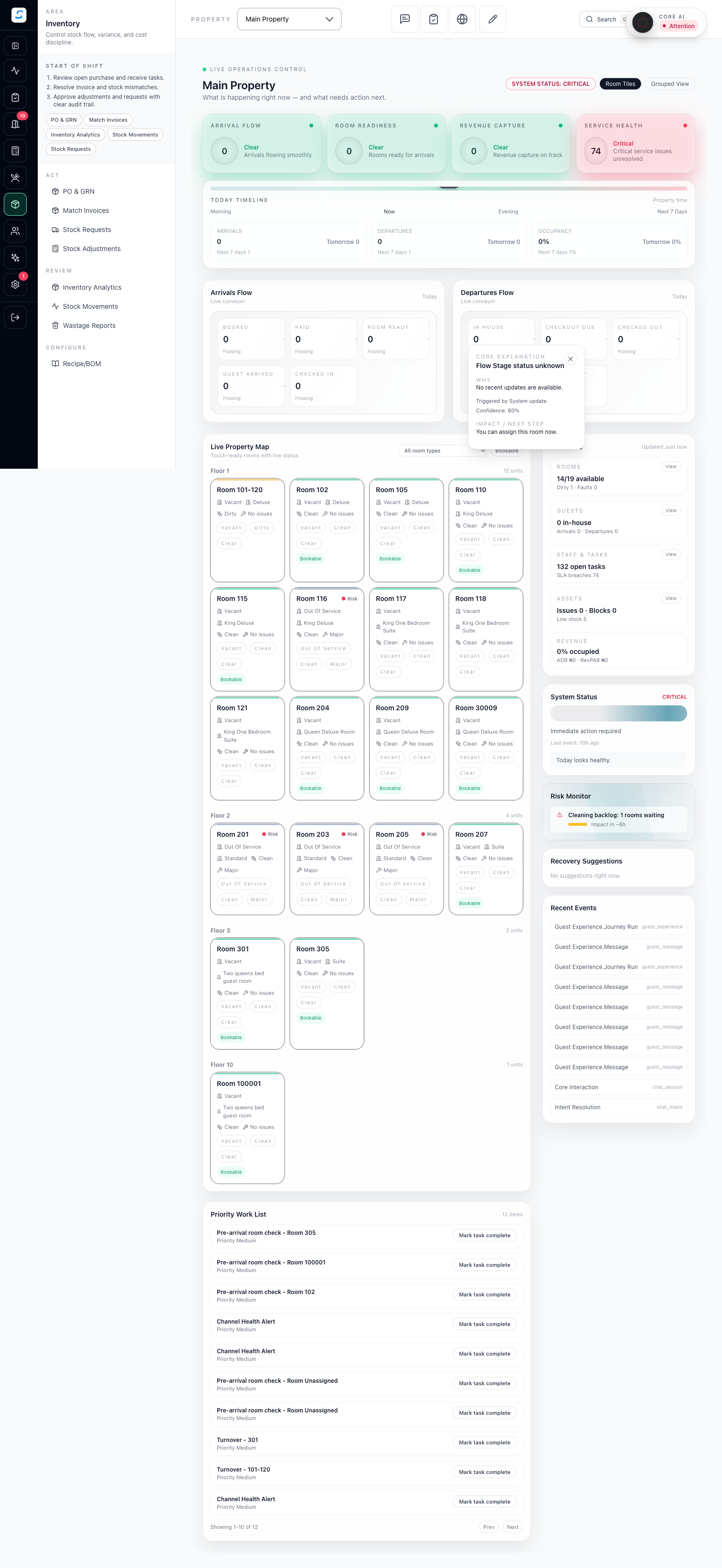
The fix is not more meetings. The fix is a single operating layer. Staycore’s operations governance, revenue intelligence, and inventory and assets modules all point toward the same principle: the hotel should not rely on separate records to explain one stay.
When a hotel gets this right, a manager can answer the basic questions quickly: Who is in the room? Has the stay been paid for? Did housekeeping clear it? Did the outlet post any charges? Is access still valid? If any answer requires a long chain of messages, the operation is too fragmented.
Why the problem is sharper in Nigeria
In Nigeria, the pressure is not abstract. Properties have to operate through network issues, mixed payment types, active walk-ins, corporate exceptions, guest follow-ups on WhatsApp, and sometimes power or device constraints. Those realities make disconnected systems more dangerous, not less, because every exception increases the chance that someone will improvise.
That is why a hotel in Lagos or Abuja cannot afford a stack that assumes perfect conditions. If the front desk needs one system, the outlet another, and the lock vendor a third, the operation will slowly build informal workarounds. Those workarounds are not harmless. They are where leakage becomes normal.
Shortlets and serviced apartments feel this too. A late arrival, a stay extension, a cleaning cycle, or a lock code change can all happen in the wrong order if the records do not flow together. The same applies to hotels that run bars, restaurants, or lounges inside the property. One disconnected step is enough to create a compounding problem.
This is why Nigerian operators should not evaluate hotel software only by price. The better question is whether the system reduces human bridging work. If the team is still bridging records manually at the end of the day, the software is not really solving the control problem.
For buyers comparing fit, see choosing the right PMS for your hotel in Lagos and compare commercial fit on Staycore pricing.
What a connected hotel should look like
A connected hotel does not mean more screens. It means fewer arguments. Booking creates the room record. Payment state determines whether access can continue. Housekeeping sees room readiness in the same flow. POS charges post into the same guest or outlet record. Finance reviews one set of exceptions instead of reconciling several disconnected systems.
Good integration also means fewer manual overrides. There will still be exceptions, but they should be visible and attributable. If a supervisor allows an early check-in, the record should show it. If a guest receives a room move, the system should show it. If a discount is approved, the manager should be able to audit it later.
| Signal of a connected stack | What it tells management |
|---|---|
| Booking, payment, and access agree | The hotel is enforcing the commercial record physically. |
| Housekeeping and front desk share room status | Turnaround time is visible and service is calmer. |
| Outlet charges post into the guest record | Revenue does not disappear into manual side channels. |
| Variance is reviewed in real time | Management can act before the leak becomes habit. |
The result is not just less leakage. It is better service. The desk is calmer, the guest moves faster, and ownership gets a cleaner picture of how the business is performing.
How to fix the stack without overcomplicating it
Do not start with ten tools. Start with the critical path: bookings, room status, payment state, and access. Once that works cleanly, add outlet billing, housekeeping, inventory, and reporting. The order matters because trying to solve everything at once often recreates the same fragmentation in a new shape.
The implementation should be boring in the best sense. One source of truth. One permission model. One room status board. One approval trail. One place to look when something goes wrong. That is what operators actually need. They do not need another dashboard that looks impressive and still requires someone to interpret the truth later.
Train the team on the sequence, not just the screens. What happens when a guest extends? What happens when payment fails? What happens when housekeeping has not cleared a room? What happens when POS bills need to post to a room? The answers should be system answers, not personality-dependent answers.
- Map the booking-to-access journey first.
- Connect room status and payment state to the same operating record.
- Bring POS, housekeeping, and inventory into the same review rhythm.
- Use audit trails to review exceptions by shift and department.
If you want the practical next step, talk to Staycore through Staycore consultation or review the commerce and reservations module to see how booking and inventory can share one commercial logic.
Hotels fail when the system asks people to do the system’s job
Disconnected systems fail hotels because they ask people to hold the truth together manually. That is not scalable, and it is not reliable. The hotel either enforces its commercial rules in software or it leaves the team to improvise under pressure. The second approach always looks cheaper until the leakage shows up.
The better model is simple: one booking record, one payment state, one room status, one access rule, and one audit trail. When those pieces agree, the hotel becomes easier to run and harder to leak. That is what serious control looks like in Nigerian hospitality.
If your current stack still treats booking, access, housekeeping, and billing as separate conversations, the business is paying for the gap every day. Close the gap before it becomes normal.
FAQ
Frequently asked questions
What does a disconnected hotel system mean?
Why is that a problem for hotels?
Can integration really reduce leakage?
Does this matter for smaller hotels?
Next step
See the integrated Staycore stack
Review how Staycore connects booking logic, room control, and access enforcement inside one operating layer.
Series navigation
Revenue Leakage Control
A control-first editorial cluster for Nigerian hotel owners and operators who want to stop cash leakage, staff bypasses, unlogged stays, room fraud, and disconnected-system losses.